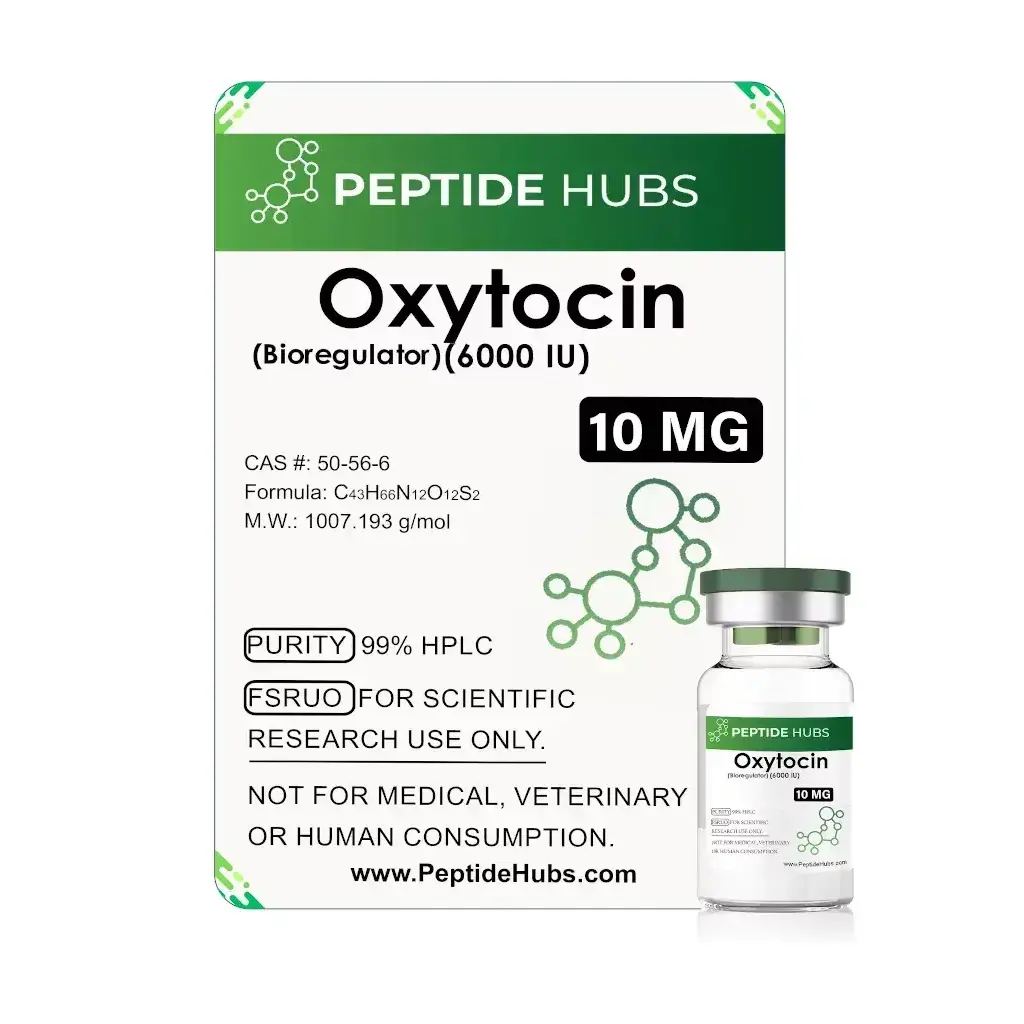
Oxytocin 10 mg – Peptide Hubs
Oxytocin is a naturally occurring neuropeptide and hormone produced in the hypothalamus and secreted by the posterior pituitary. It plays a key role in regulating social bonding, empathy, stress modulation, emotional connection, and trust behaviors. Peptide Hubs offers Oxytocin 10 mg in high-purity lyophilized form for scientific research exploring psychoneuroendocrinology and behavior.
Mechanism of Action
Oxytocin interacts with its specific G-protein-coupled receptor (OXTR), highly expressed in the brain, heart, and reproductive organs. Its activation influences emotional processing centers including the amygdala and hypothalamus, impacting fear, bonding, and social memory. Additionally, oxytocin modulates stress by attenuating cortisol levels. Learn more from this NIH review on oxytocin and social cognition.
Primary Research Applications
- Studies on social bonding, trust, and empathy
- Neuropsychiatric disorder models: PTSD, anxiety, autism
- Cortisol modulation and stress resilience research
- Reproductive and lactation-related investigations
In modern psychoneuroendocrinology models, oxytocin is often stacked with DSIP to study circadian influences on social behavior, or with N-Acetyl Selank Amidate for anxiety and emotional reactivity protocols. It may also be paired with Humanin to investigate age-related declines in bonding and cognitive empathy. For metabolism-affecting studies, researchers may include Semaglutide.
Technical Details
Peptide Type
Cyclic Neuropeptide Hormone
Peptide Sequence
Cys-Tyr-Ile-Gln-Asn-Cys-Pro-Leu-Gly-NH₂
Peptide Length
9 Amino-Acid Residues
Cyclic Structure
Cys¹-Cys⁶ Disulfide Bridge
Terminal Form
C-Terminal Glycinamide (-Gly-NH₂)
Molecular Formula
C₄₃H₆₆N₁₂O₁₂S₂
Molecular Weight
1007.2 g/mol
Primary Receptor
Oxytocin Receptor (OXTR)
Receptor Class
G Protein-Coupled Receptor (GPCR)
Dosage & Usage Guidelines
- Dosage: 10–40 IU daily (intranasal or subcutaneous)
- Administration: Intranasal preferred for CNS targeting; subcutaneous for systemic studies
- Duration: Varies based on behavioral or hormonal protocol (typically 2–4 weeks)
Stacking Recommendations
- DSIP – for sleep/emotion axis interaction
- N-Acetyl Selank Amidate – for anxiety suppression synergy
- Humanin – in neuroprotection and age-related behavioral models
- Semaglutide – to explore emotional regulation in metabolic research
Safety & Legal Status
Oxytocin is not FDA-approved for over-the-counter use and is offered strictly for research purposes only. No significant liver, blood pressure, or androgenic effects have been noted in preclinical trials. All studies should comply with local regulations and ethical guidelines.
Shipping & Product Authenticity
USA Domestic
4–5 business days
International
13–15 business days
Order Processing
24–48 business hours
Tracking
Tracking number provided
Direct Supply & Discreet Delivery
This product is supplied through the official Peptide Hubs distribution chain and shipped in original manufacturer packaging. The outer shipping package remains discreet, with privacy-focused handling and no unnecessary external product details.
What to Expect
- ✔ Orders are processed after payment confirmation
- ✔ USA Domestic shipping is typically faster when local stock is selected
- ✔ International orders include tracking, though update frequency may vary by destination
- ✔ Multiple warehouses may result in separate shipments when applicable
Authenticity support: official Peptide Hubs presentation, batch-linked lab proof, and original packaging help reinforce product legitimacy and buyer confidence.
Verified Supply
For complete delivery details, tracking policy, and reshipment terms, please see our Shipping Info page.
Storage
Store the lyophilized powder at controlled room temperature (15–25°C) in a dry, dark place, away from direct light and moisture. The unopened vial should be kept in its original packaging to maintain stability.
After reconstitution, store the solution at 2–8°C and use within 14 days. Do not freeze. Discard any unused portion after the recommended storage period. Before use, inspect the solution and avoid use if it appears cloudy, discolored, or contains particulate matter, or if the vial or seal is compromised.
Keep out of reach of children. Follow proper handling and sterile injection practices during research use.
Proper storage conditions help maintain product stability and consistent performance across the product's shelf life.
Frequently Asked Questions
What is Oxytocin used for in research?
Oxytocin is studied for its role in emotional bonding, empathy, trust, stress modulation, and neuropsychiatric disorders like autism and PTSD.
Is Oxytocin a sedative or stimulant?
No. Oxytocin is neither a sedative nor stimulant. It modulates emotional and social responses without causing drowsiness or hyperactivity.
Can Oxytocin be stacked with other peptides?
Yes. It is commonly combined with peptides like DSIP, Selank, or Humanin to study complex behaviors involving mood, cognition, and social interaction.
Is Oxytocin FDA approved?
Oxytocin is FDA-approved for specific clinical uses (e.g. childbirth), but this version is offered for non-clinical laboratory research only.
No reviews found
Please log in to write Oxytocin 10 mg review.